Mar 27, 2026
Quiet Luxury in 2026: AI Visuals for Luxury Listings
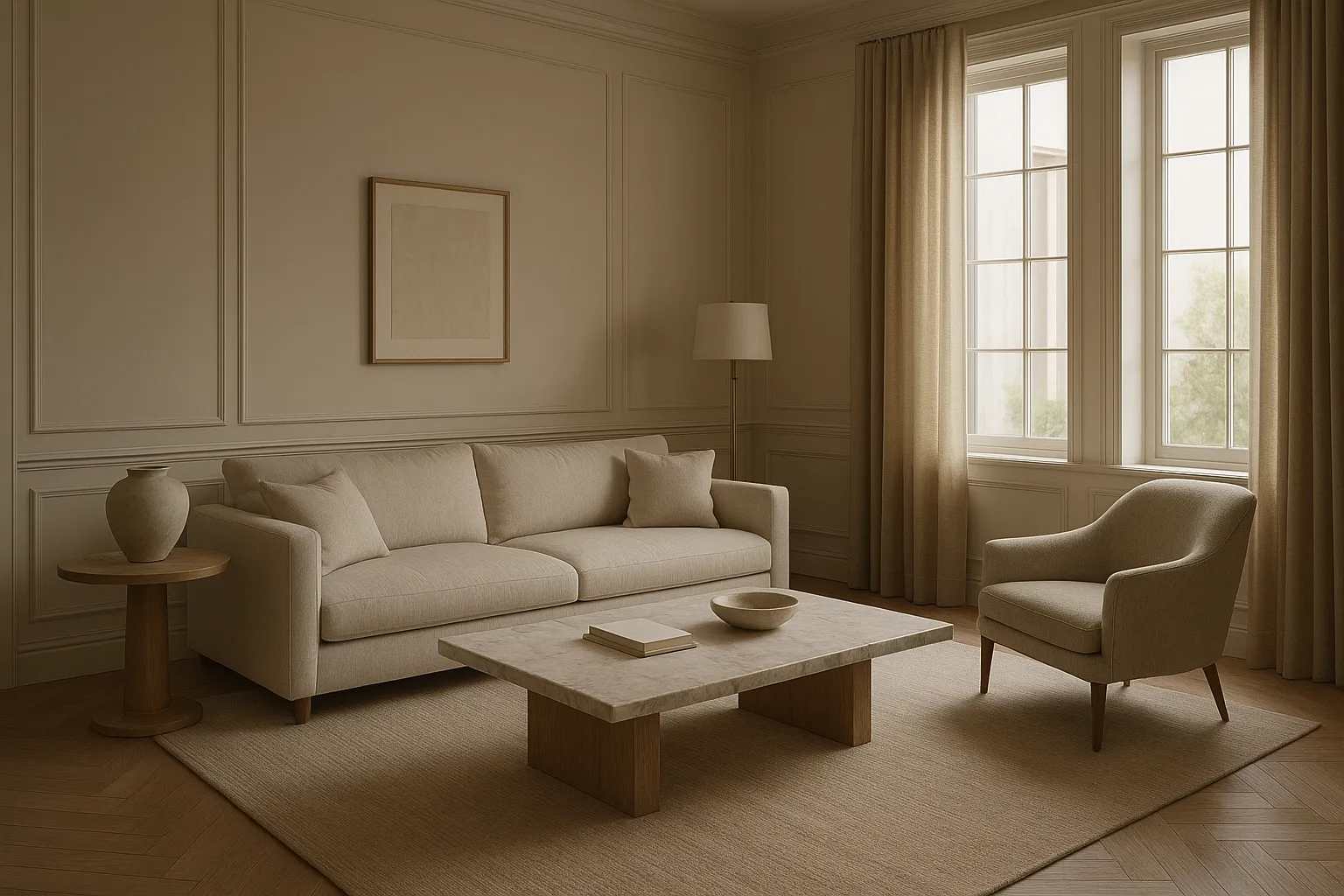
Luxury buyers have always been picky. What’s different in 2026 is what they’re picky about.
The era of “look at me” staging—overstyled shelves, loud accent colors, trendy decor stacks—has started to read as cheap. Not because the items are inexpensive, but because the overall signal is wrong.
High-net-worth buyers are gravitating toward quiet luxury: a design language built on restraint, craftsmanship, and materials that don’t need to shout.
For listing agents, that shift creates a very practical problem:
Your luxury listing is judged online first.
Your visuals need to feel high-end instantly.
And if the staging looks busy, inconsistent, or obviously fake, the buyer doesn’t “kind of dislike it.” They lose confidence.
This post breaks down what quiet luxury looks like in 2026, why premium listings fail without premium digital visuals, and how to use AI staging to create a cohesive, old-money aesthetic—without crossing the line into misrepresentation.
What Defines 'Quiet Luxury' in 2026 Interior Design?
(Here’s what quiet luxury interior design signals at first glance.)
Quiet luxury is the opposite of trend-chasing. It’s a calm, timeless look that communicates quality through materials, proportion, and negative space.
A useful way to think about it: quiet luxury isn’t “minimal.” It’s intentional.
According to Decorilla’s quiet luxury interior design guide (2024), the style is rooted in understated elegance—where texture and craftsmanship do the heavy lifting.
Here are the most consistent cues you’ll see in 2026 luxury interiors:
Premium textures (not more decor)
Quiet luxury reads “expensive” because of tactile materials—linen, wool, stone, natural oak, subtle veining in marble, brushed metal finishes.
The mistake agents make is adding more objects when the goal is better surfaces.
Tonal neutrals with depth
Think warm whites, soft greige, taupe, camel, stone, mushroom, deep olive—tones that feel calm but layered.
What to avoid: harsh contrast, high-saturation accents, or anything that screams “this was picked for Instagram.”
Classic silhouettes and clean lines
Furniture shapes are simple, but not generic: tailored sofas, sculptural chairs, refined casegoods. The room still feels livable, but nothing is trying to be the star.
Curated restraint (negative space is part of the design)
If everything is filled, nothing feels premium.
Quiet luxury lets architecture breathe: wide walkways, clean sightlines, fewer but better pieces.
Key Takeaway: In 2026, luxury staging is less about “showing what fits” and more about showing what belongs.
Why Do Luxury Listings Fail Without High-End Digital Visuals?
(And why luxury real estate marketing 2026 is increasingly a visuals game.)
Luxury listings don’t fail because the home isn’t beautiful.
They fail because the visual story doesn’t match the price point.
A buyer can forgive dated finishes in person. What they don’t forgive is a listing that looks careless, inconsistent, or low effort—because those are trust problems.
Here are the most common ways premium listings lose momentum online.
1) Visual noise makes the home feel smaller—and cheaper
Busy staging (too many accessories, too many competing styles) flattens a luxury space.
Instead of “grand,” the buyer reads “crowded.” Instead of “refined,” they read “decorated.”
Quiet luxury solves this by focusing attention on:
ceiling height
trim details
light quality
proportion
finish continuity
2) Inconsistent visuals break believability
Luxury buyers notice details. If the living room feels like one design direction and the primary bedroom looks like a completely different home, it creates friction.
Even if they can’t articulate it, the reaction is simple: something’s off.
This matters even more when you have:
multiple angles per room
twilight + daytime sets
a mix of photographer sources
a blend of staged and unstaged photos
3) Low-grade digital staging is worse than no staging
If the staging looks obviously pasted in—wrong scale, flat lighting, blurry textures—you’re not adding value. You’re creating doubt.
And doubt is deadly in luxury.
What Does “Cheap” AI Staging Look Like (and How Do You Avoid It)?
If you’re marketing to high-net-worth buyers, your goal isn’t “AI staging.” Your goal is luxury-grade visuals that happen to be produced efficiently.
Use this checklist to pressure-test your images before they go live.
Quiet luxury quality checklist for staging
Scale is believable: furniture fits the room. No oversized sofas. No tiny rugs floating in space.
Lighting matches the photo: shadows fall in the same direction as the natural light.
Textures look tactile: you can almost feel the linen, wood grain, or wool.
Decor is restrained: fewer objects, more intention. No cluttered shelves or random plants everywhere.
Palette is coherent: neutrals are consistent across rooms (not beige in one room, bright white in another).
The home stays the hero: staging supports architecture—it doesn’t compete with it.
Pro Tip: If your staging draws attention to itself, it’s not quiet luxury. The buyer should be thinking “I want to live here,” not “nice couch.”
How Do You Use AI Staging for High-End Listings Without Losing the “Old Money” Vibe?
(Practical AI staging for high-end listings starts with restraint, not decor.)
AI staging is at its best when you treat it like a visual standardization tool—not a decor generator.
Here’s a practical workflow you can run on a luxury listing.
Step 1: Start with a clean canvas (declutter before you style)
Quiet luxury needs calm. That’s hard to achieve if the room is visually chaotic.
Before you stage, remove distractions:
excess furniture
busy personal items
mismatched decor
anything that pulls focus away from architectural features
Step 2: Pick a quiet-luxury “design spine” for the entire listing
High-end staging should feel like one designer touched the whole home.
Define 4 decisions up front:
Palette (warm neutral base + one deep accent tone)
Material story (linen + oak + stone; brass as a small highlight)
Silhouette (tailored, low-profile, sculptural)
Decor rule (“one statement piece per room, max”)
Step 3: Use style selection to stay consistent across rooms
When you’re staging digitally, consistency is a choice.
If you want an example workflow, start with a consistent, quiet-luxury look using Collov AI virtual staging—and treat your style choice as a listing-wide preset, not a room-by-room experiment.
If your goal is a high-end buyer, choose styles that privilege:
restraint over novelty
texture over accessories
timeless silhouettes over trendy pieces
You’re not trying to impress the algorithm. You’re trying to impress someone who’s seen better.
Step 4: Prioritize multi-angle consistency (luxury buyers notice)
Luxury marketing is rarely one hero shot. It’s a set.
If your living room has multiple angles, consistency matters: the same design language, the same furniture story, and a believable layout.
Use a multi-angle staging workflow that keeps furniture and styling consistent across shots. When your angles don’t match, luxury buyers spot it immediately.
Step 5: Don’t skip the unglamorous part—photo quality
Even tasteful staging can look cheap if the underlying photo is dull, noisy, or poorly balanced.
Luxury visuals should feel crisp and intentional. If you’re enhancing photos, keep it realistic: correct exposure, color balance, and clarity—without “beauty filtering” the property into something it isn’t.
Where Does “Digital Luxury Renovation” Fit Into 2026 Marketing?
In 2026, buyers are comfortable with a home that needs work. What they’re not comfortable with is uncertainty.
That’s where digital luxury renovation comes in: using visual previews to show what the home could become—particularly for:
dated kitchens
tired bathrooms
flooring/paint modernization
material upgrades that match quiet luxury (stone, oak, plaster finishes)
The critical guardrail: renovation previews should be framed as conceptual, not as the current condition.
Done right, these visuals help buyers:
understand the potential
mentally price the updates
move from “I can’t see it” to “I get it”
Done wrong, they feel deceptive.
What Should You Disclose When You Use AI Visuals on Luxury Listings?
Luxury buyers don’t just buy the home. They buy the trust.
Virtual staging can support that trust—if you’re transparent.
Florida Realtors is blunt about the basics: clearly label virtually staged images, include the original photos, and avoid misleading edits like changing dimensions or hiding defects (see Florida Realtors’ virtual staging guidance (2025)).
Here’s a simple disclosure standard that protects you:
Label images as “Virtually Staged”
Include the original image alongside it (or in the same gallery)
Keep edits cosmetic (furniture + decor) rather than structural
Never remove or conceal material issues
⚠️ Warning: If your visual “improvement” changes what a buyer would consider a material fact, you’re not staging—you’re misrepresenting.
What’s a Practical “Quiet Luxury” Visual Standard for Luxury Real Estate Marketing 2026?
If you want to win in luxury real estate marketing in 2026, don’t chase aesthetics.
Chase consistency.
Use this standard before you publish your next premium listing.
The quiet luxury listing visual standard (quick audit)
One palette across the home (tonal neutrals; no random rooms)
One material story (wood/stone/linen; minimal mixed metals)
One silhouette language (tailored, classic, quiet)
Less decor than you think you need (negative space is intentional)
No staging that competes with architecture
No obvious digital artifacts (edges, shadows, scale)
Disclose staged images + include originals
If you hit those seven, your listing won’t just look “nice.” It’ll look credible.
Next steps (low-commitment)
If you want to test this on a real listing, pick one hero space (usually the living room), and create a quiet-luxury version plus one alternate. Keep the palette and silhouettes consistent, then build the rest of the photo set to match.
When you’re ready, use the workflow end-to-end: stage one hero space, validate the vibe, then scale it across the listing.
If you want a fast starting point, try Collov AI on 1–3 images first—then expand once the look feels right.