Mar 19, 2026
How to Sell New Construction Homes Before They’re Built: AI Staging Guide

Every day a newly framed home sits, interest eats margin.
Carrying costs don’t care that the cabinets aren’t in yet.
In our experience working with top developers, the teams that win pre‑completion sales remove imagination as a barrier and standardize the drywall‑to‑contract workflow.
Why Do Buyers Struggle to Purchase Unfinished Homes?
Most people find it hard to translate studs, drywall, and 2D plans into a lived reality.
Spatial reasoning varies widely, and empty rooms lack the cues people use to judge scale, light, and furniture flow.
When affordability is tight and incentives are common, hesitation grows—accelerating clarity with visuals is no longer optional, it’s operational.
The human brain anchors on context: windows, sightlines, and furniture scale create “fit” signals fast.
Empty rooms offer few anchors, so buyers over‑ or under‑estimate room utility and storage.
2D floor plans can feel abstract; multi‑angle visuals close the gap between plan and perception.
You can cut that hesitation with repeatable visuals built from field photos.
If you’re evaluating tools to operationalize this, you can try AI virtual staging as a low‑friction first step.
According to the National Association of Home Builders, builders face affordability pressure and cautious demand into 2026, making faster pre‑sales a margin lever. See the context in the NAHB 2026 Housing Outlook.
How Does AI Virtual Staging Compare to Physical Model Homes?
Before spending on a model or waiting on a render pipeline, align on cost, time, and flexibility.
Keep the comparison neutral and focus on operational fit by community and plan mix.
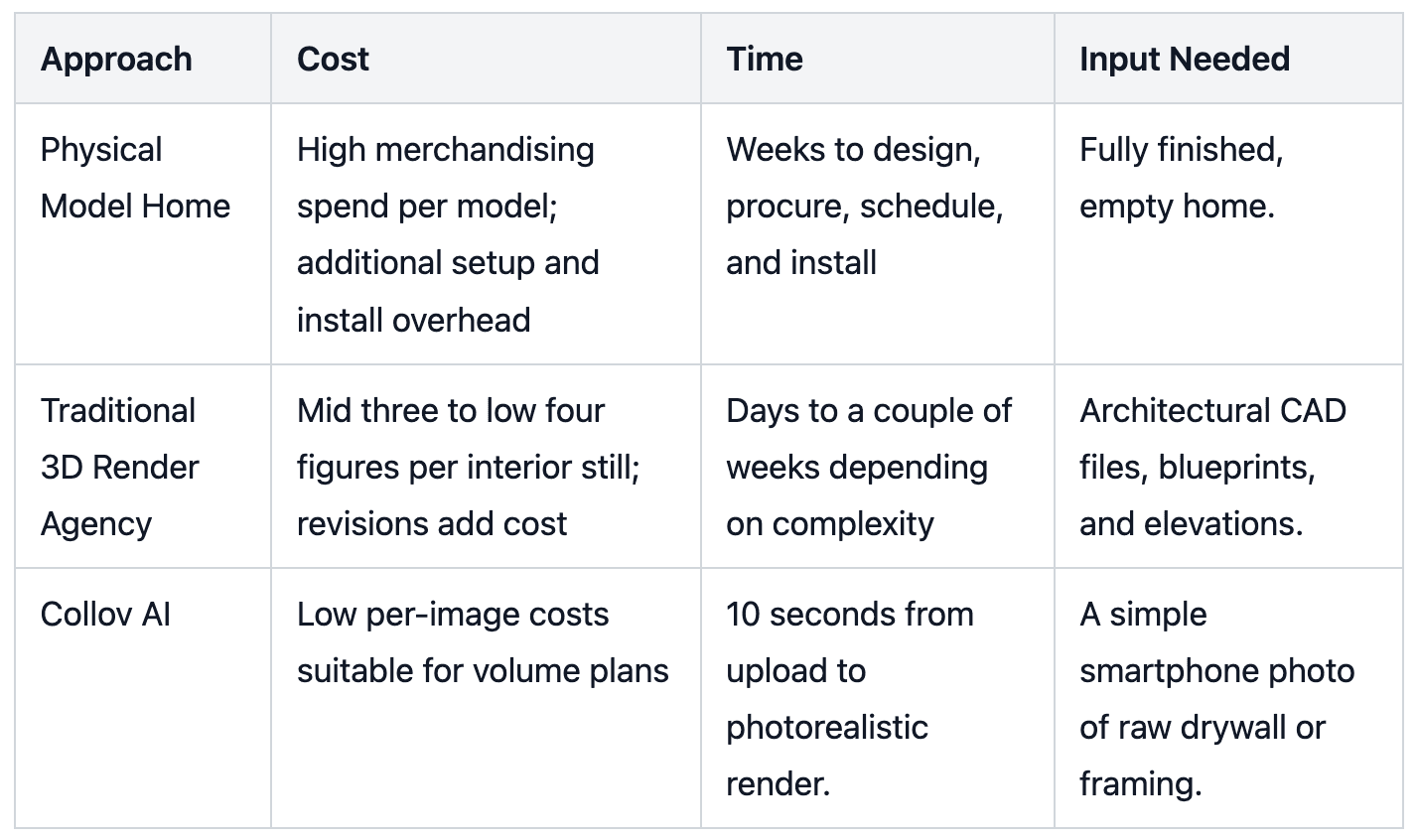
Use the table to set expectations by plan series and buyer persona.
For spec homes, speed and iteration usually outrank showroom polish.
For flagship communities, you may combine a single physical model with staged assets across all elevations.
To protect slim marketing budgets, understand where dollars go in a typical build. The NAHB’s 2024 construction cost study shows construction comprises 64%+ of the sales price, with marketing a small slice—tightening the case for fast, repeatable assets. Review the shares in NAHB’s Cost of Constructing a Home (2024).
What is the Best Workflow to Stage a House from Drywall?
This is the playbook we implement with regional builders to move from “empties” to marketing‑ready visuals in a single shift.
It assumes smartphone captures by supers or sales teams at the drywall or framed stage.
Prep the space
Coordinate with site supers for safe access; follow PPE requirements.
Clear debris from key sightlines; note plan, elevation, and lot.
Capture standards
Use a recent smartphone; keep lens at ~4–5 ft for natural perspective.
For each major room, shoot 2–3 corners and a straight‑on wall; include windows/doors for scale.
Lighting and exposure
Favor daytime, indirect light; avoid harsh backlight.
Tap to expose mid‑tones; take 3–5 shots per angle for a sharp option.
File governance
Name files: Community_Plan_Elevation_Phase_Room_Angle#_YYYYMMDD.jpg.
Keep originals; folder by lot/plan; map originals → staged outputs for audit.
Staging pass
Upload selects; choose a consistent design style per plan series.
Leverage Collov AI's proprietary Architectural Recognition Engine. Unlike generic AI that gets confused by exposed pipes and studs, this engine perfectly maps raw geometry and proportions, turning a rough smartphone photo into a perfectly scaled, finished room instantly.
Review and compliance
Cross‑check against plans; don’t imply finishes that won’t be delivered.
Add a visible watermark: “Builder’s Concept” or “Proposed Finish.”
Publish and measure
Export high‑res JPEG/WEBP with metadata.
Publish to site/MLS per local rules; track engagement and days‑to‑contract methodically.
[Image Placeholder: Split-screen. Left: Raw drywall/framed room. Right: Photorealistic living room staged by Collov AI]
Practical note: In our experience working with top developers, multi‑angle captures of kitchens, great rooms, and primary suites do most of the heavy lifting for buyer clarity.
Can You Legally Market Unfinished Homes with AI Images?
Yes—if you disclose clearly, avoid misrepresentation, and keep an audit trail.
The principle is simple: the visual claim must match the disclosure and the as‑built constraints.
Watermark every staged image with “Builder’s Concept” or “Proposed Finish.”
Retain and, where required by MLS, publish the original unedited photo adjacent to the staged one.
Don’t alter structural elements or windows/doors; avoid showing fixtures/options that won’t be offered.
Add copy near images stating that finishes, fixtures, and landscaping may vary by plan and selection.
Verify local MLS and state advertising standards; document your workflow and approvals.
Governance checklist
Keep a changelog mapping original → staged output → plan/elevation ID.
Store approvals and notes in your asset library.
Train sales to reference disclosures consistently during tours and virtual appointments.
What Should Builders Expect at Scale?
At 50–500 homes a year, repeatability beats hero content.
Your goal is a standard kit: capture SOP, naming, review, watermarking, publishing, and measurement—applied across communities.
Team playbook
Assign one capture owner per community; calendar weekly site sweeps.
Centralize staging requests; bundle angles by plan to maintain consistency.
Measure outputs: assets per plan, turnaround time, usage by channel, and days‑to‑contract deltas.
Technology and integration
Maintain a searchable asset library tied to plan set IDs and elevations.
Use APIs to route images from capture to staging to CMS/MLS with audit trails.
Standardize design presets per persona (first‑time, move‑up, downsizer) to accelerate iteration.
When your division is ready to connect systems and automate staging at volume, evaluate Collov AI enterprise solutions for workflow and API fit.
What’s the Bottom Line for Builder Margins?
Every week shaved before completion reduces exposure to interest carry and incentives.
You don’t need a showroom in every community to sell the vision.
Use AI virtual staging to convert drywall into decision‑ready visuals within a day.
Focus on the rooms that sell: kitchen, great room, primary suite.
Disclose clearly, keep originals, and standardize your governance.
Stop paying carrying costs on dirt and drywall. Equip your sales team to sell the vision right on the job site. Generate photorealistic model homes from simple smartphone photos in exactly 10 seconds.
Try Collov AI Virtual Staging for Free Today at https://collov.ai/virtual-staging