Mar 17, 2026
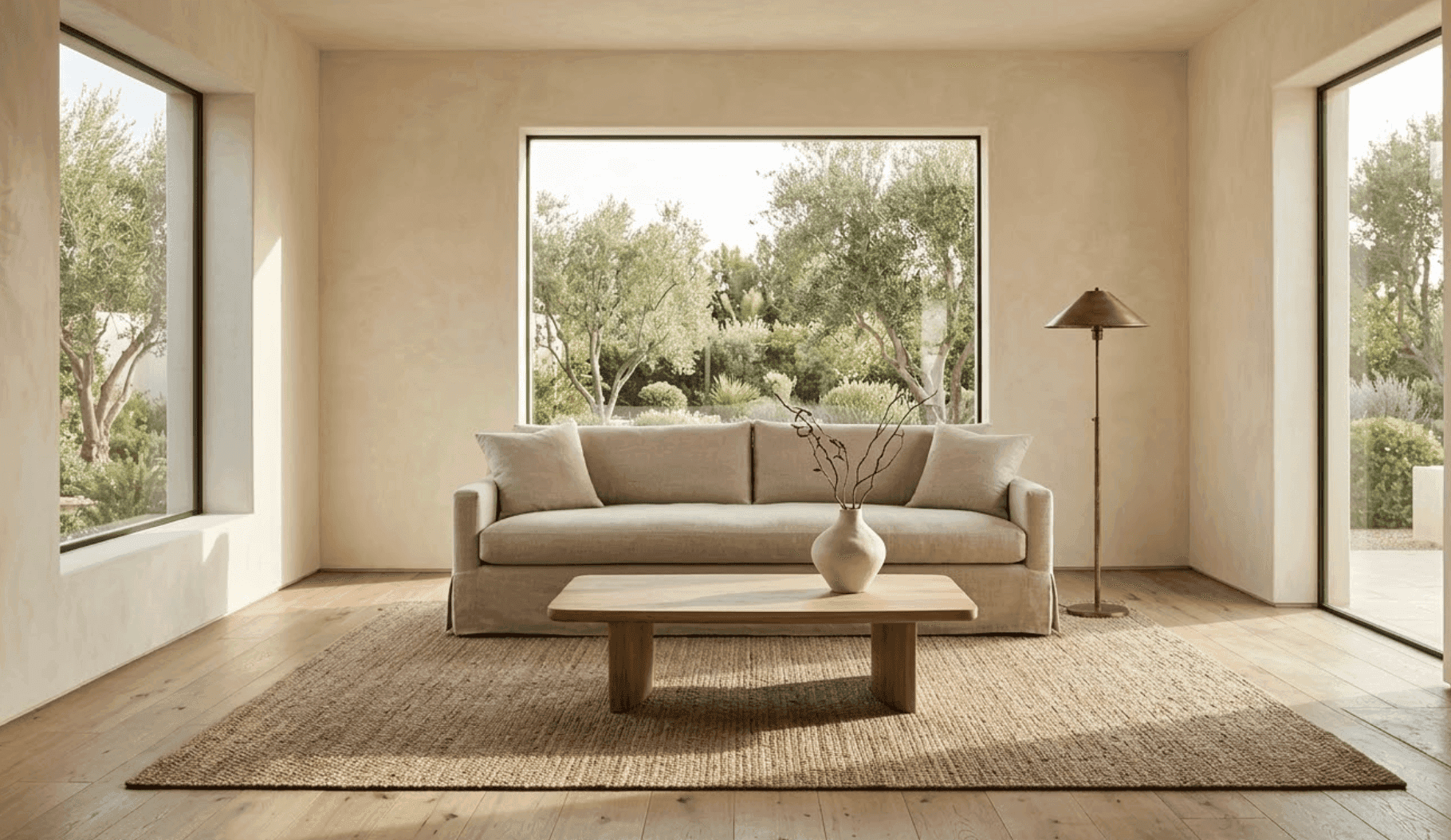
Millennial and Gen‑Z luxury buyers aren’t swooning over sterile, all‑gray flips anymore. They want texture they can almost feel through the screen—plastery walls, raw wood, natural fibers, and patina that reads lived‑in, not lab. Our hero use case in 2026 is clear: the newly renovated but “too‑gray” flip that photographs cold. The good news? You don’t need boutique furniture rentals to fix it. You can apply Warm Minimalism and Wabi‑Sabi digitally to produce magazine‑ready images that invite higher‑quality offers.
Why Warm Minimalism Real Estate and Wabi‑Sabi move buyers now
Warm Minimalism softens clean lines with tactile layers—think linen instead of lacquer, patina over polish, and tonal neutrals that feel calm rather than clinical. Wabi‑Sabi adds the human touch: a respect for imperfection, natural variation, and honest materials. Recent design coverage shows the shift is mainstream in 2026, with trend editors praising plaster‑like wall finishes, textured neutrals, and aged woods as antidotes to formulaic gray rooms. Multiple features from design media highlight warm off‑whites, organic linens, and aged timber as the look of the moment; see roundups from Homes & Gardens (2025–2026) and Dezeen’s interiors outlook (2026) for representative examples.
The cost problem: boutique physical staging vs. digital alternatives
High‑end physical staging adds up quickly—especially if you’re renting artisanal pieces and keeping them for multiple months. According to Angi’s 2026 guide, typical staging averages around $1,800, with many projects ranging roughly $800 to $2,900, and furniture rentals commonly running $300 to $700 per staged room per month. Bankrate’s 2025 analysis similarly pegs typical costs near $1,800 and notes that for luxury homes, total staging often lands around 1%–1.25% of list price when rentals stretch across the listing window. Those numbers climb fast when you chase the exact textures buyers expect.
What does it buy you? Staging still matters. The National Association of REALTORS® (NAR) reported in 2025 that nearly 29% of agents saw offer values increase 1%–10% on staged homes, and 49% of sellers’ agents observed reduced days on market—agent‑reported ranges, not guarantees. Meanwhile, NAR’s AI resource hub notes that agents who use AR to market properties have seen conversion lifts (up to 40%) and staging cost reductions (up to 97%) in cited examples. For a “too‑gray” flip, that points to an obvious, lower‑risk test: render the right textures digitally first via high‑end AI virtual staging.
A 24–48 hour playbook to “warm‑correct” a gray flip
Here’s a practical, no‑jargon workflow you can run between photos on Monday and your listing going live mid‑week. Think of it this way: a texture‑first makeover—no sawdust required.
Select the right rooms and angles
Prioritize the living room hero, kitchen wide, and primary bedroom. Add one exterior twilight or patio scene if it’s part of the lifestyle story—day-to-dusk style photo enhancement can help that exterior shot read warmer and more inviting. Aim for 2 angles per key room.
Define the style lane per room
Warm Minimalism lane: limewash‑like wall feel in warm ivory; raw or white‑oak casegoods; linen upholstery; woven natural‑fiber rug; warm brass or bronze accents; tonal neutral palette with mushroom/olive notes.
Wabi‑Sabi lane: a touch more asymmetry and “handmade”—subtly irregular ceramics, visible wood grain, unlacquered metals, stone or plaster‑read textures, and a lived‑in, less glossy reading.
Set the material story (keep it simple and repeatable)
Walls: soft, plaster‑read texture in warm ivory or light mushroom.
Floors and wood: raw or white‑oak tones with grain visible.
Soft goods: organic‑linen sofa or slipcover look; nubbly throw; woven jute or wool rug.
Accents: aged brass sconce, hand‑thrown vase, matte black or oil‑rubbed bronze pulls.
Calibrate light and color temperature
Favor morning or late‑afternoon warmth. Nudge away from cool blue casts so oak and linen register as tactile, not gray.
Create two variants for A/B testing
One Warm Minimalism pass (tidier, tonal, serene) and one Wabi‑Sabi‑leaning pass (slightly more asymmetry and patina). Label your files clearly for easy comparison.
Keep it honest
Don’t depict structural changes. Avoid finishes that couldn’t plausibly exist after move‑in. This is about styling and surface feel, not renovations.
If the room looks busy on camera, consider starting with a clean slate first (remove stray objects, cables, and clutter) so the textures and materials read clearly in the final images—tools like AI Furniture Eraser can help with that step.
Consistency across angles without the headache
Once you pick a style lane, consistency sells the story. Reuse the same linen tone, keep oak grain/patina coherent, and echo key accents across the living room hero, secondary angles, and adjacent rooms. A practical way to maintain that cohesion is to use a single “digital artisan” workflow that applies the same palette and textures across every shot in a set. For example, Collov AI can be used as a Digital Artisan to keep Warm Minimalism or Wabi‑Sabi cues aligned across multiple views while you iterate quickly on style details. If you need consistent furniture across views, see the platform’s Multi‑Angle Staging tutorial.
Quick styling cheat sheet (save this for your pitch deck)
Warm Minimalism cues: limewash‑like walls; raw/white‑oak; linen upholstery; woven natural‑fiber rugs; aged brass or warm bronze; tonal neutrals (ivory, oat, mushroom) with soft olive accents.
Wabi‑Sabi cues: visible wood grain and knots; hand‑glazed ceramics; unlacquered brass that will patina; stone and plaster‑read textures; asymmetry and negative space that feels intentional.
Compliance and disclosure, simplified
Use straightforward, neutral disclosures wherever virtually staged images appear. Keep captions conspicuous and consistent.
Sample caption: “This image is virtually staged to illustrate potential furnishings and finishes.”
Listing note: Add a short line near the gallery reiterating that select images are virtually staged and that actual furnishings and finishes may differ. Verify with your MLS.
For context, California’s 2025 AB‑723 discussions highlight increasing attention on how digitally altered images are presented; agents should monitor state‑level guidance and MLS rules as they evolve. When in doubt, be clear and consistent in your captions and marketing copy.
Two conservative scenarios to frame costs and outcomes
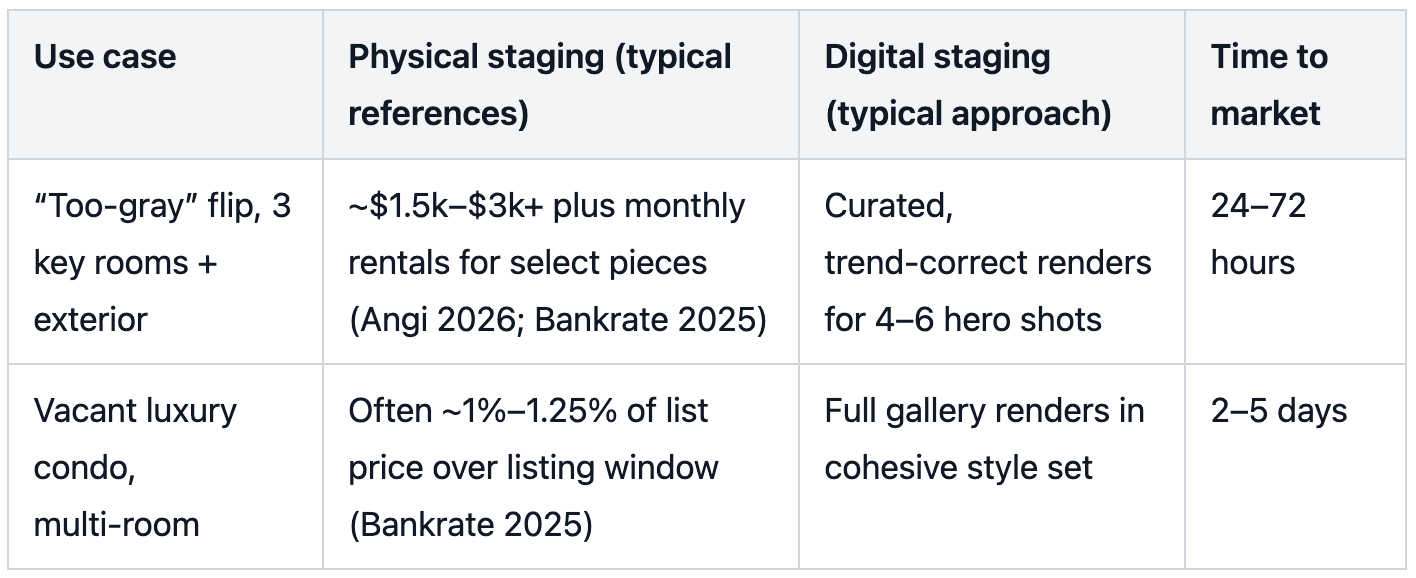
Use these as directional planning tools, not promises. Homes staged with Collov AI sell 73% faster. Scenario 1: The “de‑gray” flip that’s occupied or lightly furnished often requires selective rentals if you go physical—landing near the Angi/Bankrate midpoints ($1,500–$3,000), with premium texture‑correct pieces pushing costs higher across a 2–3 month window. The digital path, by contrast, produces curated, magazine‑ready images for a fraction of that, typically in days. Use the 73% faster figure as the simple, consistent performance headline in your pitch, and avoid stacking multiple time-on-market statistics that can vary by market and season. Scenario 2: A vacant luxury condo with great light can be spectacular—but multi‑room rentals for several months quickly escalate; Bankrate notes luxury staging often runs ~1%–1.25% of list price. A cohesive set of Warm Minimalism real estate renders or Wabi‑Sabi‑leaning images can be produced in days for testing before committing to rentals.
How to A/B test images the right way
Prepare two labeled sets: Warm Minimalism vs. Wabi‑Sabi‑leaning. Keep camera positions and crop similar so buyers focus on style differences.
Maintain identical disclosures across sets.
Soft‑launch via email to your sphere, a private page, or a coming‑soon preview; gather which set stops the scroll and earns replies.
Pick the winner, then keep the rest consistent: carry the chosen palette and textures through every angle.
Next steps: run a style‑corrected test render today
Upload three photos from your next “too‑gray” listing—living room hero, kitchen wide, and primary bedroom—and generate two labeled sets: Warm Minimalism vs. Wabi‑Sabi‑leaning.
Upload a photo of your most boring, sterile room right now and watch Collov AI transform it into a Wabi-Sabi masterpiece in seconds.
Start here: virtual staging for real estate. Then pull a few texture and palette references from Collov AI’s Idea Center for staging inspiration so your full gallery stays consistent.
References
Angi — 2026 home staging cost guide (2026): authoritative cost ranges and rental expectations for staged rooms.
Bankrate — home staging costs (2025): average spend and luxury‑listing percentage estimates.
NAR newsroom (2025): agent‑reported offer value ranges and days‑on‑market observations for staged homes.
NAR AI resource hub: notes on AR‑driven conversion lifts and staging cost reductions in cited cases.
Design media signals for style shift: 2025–2026 features from Homes & Gardens and Dezeen on Warm Minimalism, tactile walls, and imperfect interiors.